
“Bad weather” pretty much summarizes the contest for me. Both in the ionosphere and lower. Poor propagation overall and thunder storms circling my QTH. The poor propagation also drove people to other bands (except those of us who had decided to do single band). Whenever the band opened slightly to some direction, for sure there was a thunder storm in that direction and terrible QRN. My ears are still ringing from those lightning crashes – volume had to be turned up and APF on in order to copy stations. I do not want to wear headphones for a while… One could argue that it must be the lightning that fires up the ionosphere 🙂
Finally, late on Sunday afternoon the band opened to EU but then the QRN prevented me from working most of the stations. Nothing more frustrating than hearing a bunch of people calling but I can’t copy them. Then there were some minor episodes like losing the power for a bit during the contest, AC leaking condensed water into my ham shack and me being attacked by a fly swarm while trying to work. The latter was very annoying and distracting! They must have been attracted to my “contest aroma” (sweating with the AC off and no shower). And when the contest was almost over (1.5 hour left), I hear a loud rumble through my headphones and realized that a thunder storm had just developed almost exactly above my QTH. Turned off everything and pulled cables off. I kept waiting for it to go away but no, it decided not to go anywhere (game over). The timing of WPX is really bad for us due to the storm season but what can we do?
But I still managed to get 1252 QSOs and 706 prefixes. However, I am pretty sure that there are tons of copy errors because of the QRN and poor band condx (very weak signals) but that’s life…
Monthly Archives: May 2026
Multi program action example
Here is an example where in one QSO (SP5EXA) RX A decoded the first message and RX B the following message. So, the QSO would not have completed (or, well, could have after retries) without the two RXs.
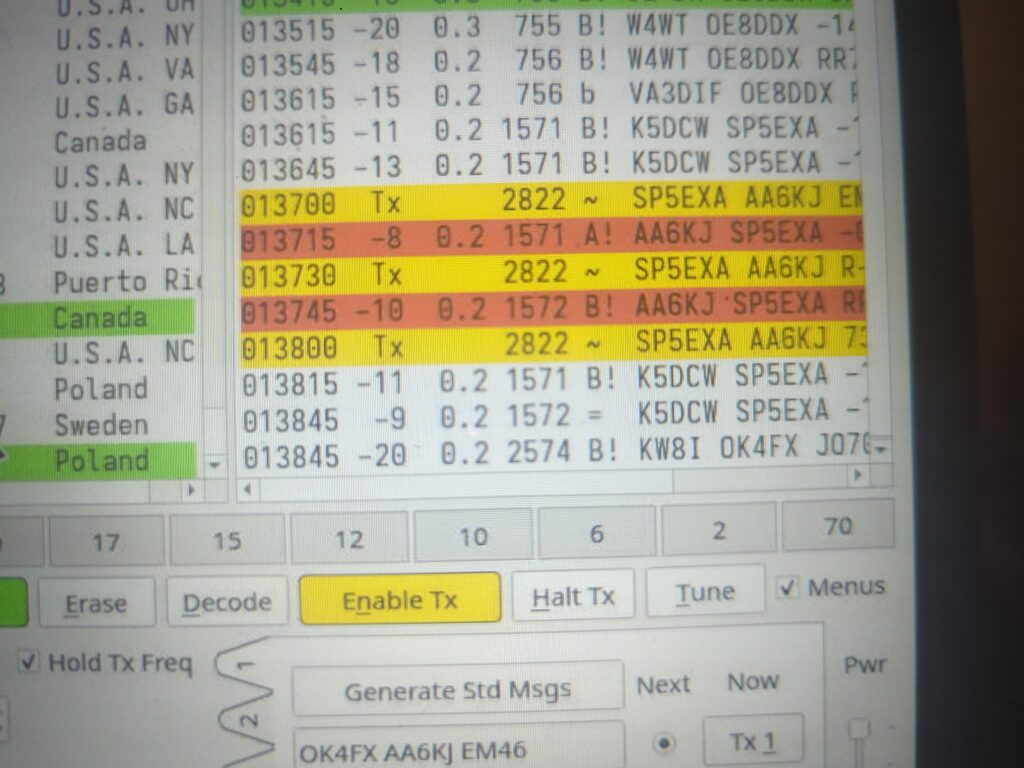
Here RX A was connected to inverted L and RX B to BOG-NE. The ! sign indicates that the decode was received only with that RX.
Factors affecting how BOG antennas work
My half empirical points for successful BOG antenna deployment:
- Poor ground conductivity is good for BOGs especially when the wire is directly on the ground. Elevating the wire will reduce influence of the ground and the results will become more consistent between different QTHs. My QTH has rocky / poor conductivity ground, so longer BOGs work well. At locations with higher ground conductivity, BOGs should be shorter.
- If you install radials, make sure that they are not too long. Three 40′ radials per end point seems to be good for 60/80/160. I also have ground rods at each end of my reversible BOG (KD9SV setup).
- Lengths of 150′ – 300′ have been typically used. I have tried 150′, 200′ and 300′. 300′ worked best in my case. It has a good pattern on 160 m, 80 m, and 60 m. I have not tried it on 40 m since I have a 3 element beam there. Distance between the BOG wire and ground affects the wire velocity factor: closer to the ground makes it electrically longer whereas elevating it reduces its electrical length (but increases the overall signal strength). My BOG is elevated slightly (4″ from ground) and hence the optimum wire length is somewhat longer than cited elsewhere (typically approx. 225′). If rising the wire more, it will eventually become a regular Beverage antenna (and needs a longer wire).
- Termination resistance: Elevating the BOG and increasing its length may require using a larger value termination resistor than the usual 240 ohm (in the KD9SV box). I have not observed any self-termination effects of my BOGs but I have not gone beyond 300′ in length.
- Having the BOG elevated slightly helps prevent accumulation of leaves etc. on the wire, which can degrade the performance. This can also reduce the chance of mice, rats, squirrels etc. eating the BOG wire. It would be best to use critter resistant wire!
There are many stories online where some people say that BOGs work great and others that have absolutely no success with these antennas. This is presumably due to different ground conductivities at the locations. It took me a while to test various setups but now I finally have a working system. It easily beats my inverted L in receiving on 160/80/60 especially when lightning is present somewhere. But I use both when receiving on the low bands (see other posts on “multi”).