I have had S7 power line noise (RFI) on 160 m for several months now (as measured on inverted-L antenna). I spent almost a month collecting observations and search for possible RFI sources nearby.
The first step was to characterize the noise source. I first observed that the noise goes away during rain, which is expected for arcing power lines. Otherwise it was constantly on 24/7 but its intensity varied slightly from day to day. During heavy winds the noise sometimes showed erratic behavior, like a bad contact. Setting my radio to AM mode on 160 m band and checking the WSJT-X water fall (starting from 0 Hz rather than the usual 200 Hz), one could clearly see peaks at 120 Hz plus its multiples. Occasionally weaker 60 Hz and multiples were also seen. All this is consistent with power line arcing. So, now I knew what I am looking for.
To locate the source, I first used my 160 m receiving antennas to get the approximate direction and then concentrated the search in that approximate direction. Since it could only be heard on the 160 m band, it is likely not very close to me (> 1 mile distance). Google Earth is a great help in mapping out the search area. When I eventually drove near the RFI source, the noise showed up on my car AM radio but then I failed to observe it on portable 120 MHz AM radio, which indicated that I could not get very close to the troublemaker (private properties with barbwire fences, animals etc.). Unfortunately, AM radio observation is often not very reliable because the noise can be conducted through the power line wires (antenna) and radiate over a large area. Fortunately, in this case the information I provided turned out to be sufficient for the power company to locate the problem.
I detailed all the findings (including proof that the RFI is not from my property) and sent a letter to the power company (Craighead Electric). They received the letter and responded the same day (9/28). Even though I was not able to pin point the exact source of the RFI, they found the problem & fixed it in just a couple of hours (9/30)! The actual broken equipment was located using ultrasonic microphone equipped with a parabolic dish. The RFI was caused by arcing of this jumper (see the brown piece on the left where some wire has evaporated):
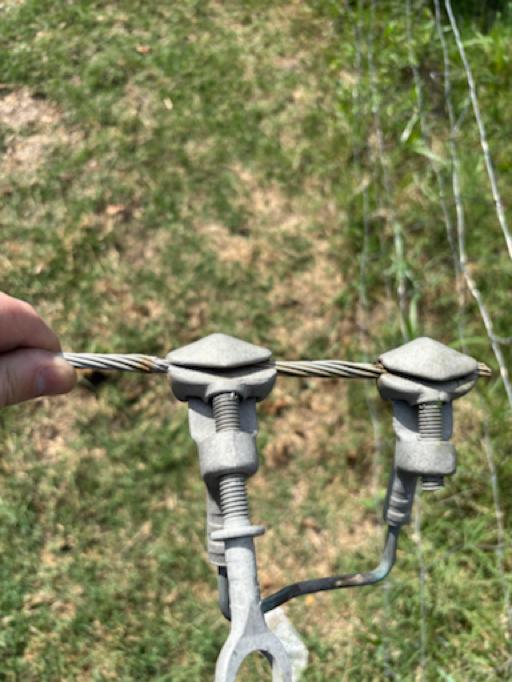
Over time this would have led to power line failure since the wire was getting evaporated slowly. When it gets thinner (increased resistance), it begins to heat more (on top of the heat produced by arcing) and this accelerates the failure process. This broken equipment was located 2.2 miles east from my QTH. There is still a smaller issue in another location but they promised to search for it soon. This RFI source I am able to hear with my 120 MHz AM handheld radio, which can determine the location more exactly. Interestingly, it can only be heard weakly on the 10 m band at my QTH, mainly because of the higher natural noise floor on the lower bands. It is approximately located 2 miles northeast from me. I used my 10 m yagi to get the direction for the search (signal maximum & side null). It has the same signature as the 160 m noise (120 Hz + multiples and goes quiet when it rains).
Now my day time noise floor sits neat at S3 on 160 m. It turns out that the grandfather of the electric company technology chief is a ham and that probably helped.
Excellent service from Craighead Electric!
Update: The smaller RFI source has disappeared on its own. The hunt will continue if it comes back.